Disclaimer:
The information provided on this website is for informational and educational purposes only and is not intended as medical advice nor is it a replacement for seeking medical treatment or professional advice. Always seek the advice of a qualified healthcare provider with any questions that you have regarding a medical treatment or condition. Never disregard medical advice or delay seeking it because of anything you have read on this website.
November 2025
nnEMF: The Cancer Connection
Joseph Corsini, Ph.D. and Julie Alessandra, MTE
Humans evolved on earth in the complete absence of modern technology. This evolution took place on the surface of the earth, with the sun and the wind and the rain. And in the earth’s magnetic field. The earth’s magnetic field is very weak compared to say a refrigerator magnet, but it encompasses the entire earth and we experience it constantly. Our cells have evolved to function under its influence, from the electrons that transfer energy quanta between carriers in the mitochondrion to generate ATP, carbon dioxide, and metabolic water, to the rapid changes of membrane potential that transmit neuronal signals throughout the body. Because of this, it might be expected that unnatural anthropogenic (man-made) electromagnetic fields (also referred to as non-native EMF or nnEMF) and electromagnetic radiation that often accompanies EMF could be detrimental to fine-tuned cellular processes, leading to diseases such as cancer. In attempting to understand this possibility scientifically, many studies have examined a hypothesized link between nnEMF and cancer, yielding a large body of conflicting results (Zhang et al 2016; Carpenter 2019; Maffei 2022). In fact, even the definition of EMF is not consistent in the literature, with otherwise reputable sources like the National Cancer Institute and the World Health Organization stating that electromagnetic radiation and electromagnetic fields are the same phenomenon, which they are not. The distinction between electromagnetic fields, electric fields, and electromagnetic radiation is clearly explained in Santini et al (2018); without digressing into a technical explanation, suffice it to say that many of our devices, including cell phones, microwaves, electric wiring in the walls, and computers, induce electric fields, generate magnetic fields, and emit low frequency non-ionizing radiation. In addition, the electric fields generated by alternating current that passes through the wiring in our homes also generates electric currents in nearby conducting materials (potentially including us). Non-ionizing radiation, electric fields, magnetic fields, and induced electric currents (collectively referred to as the EMF complex - see image below) are expected to exert effects, some potentially adverse1, on our physiology.
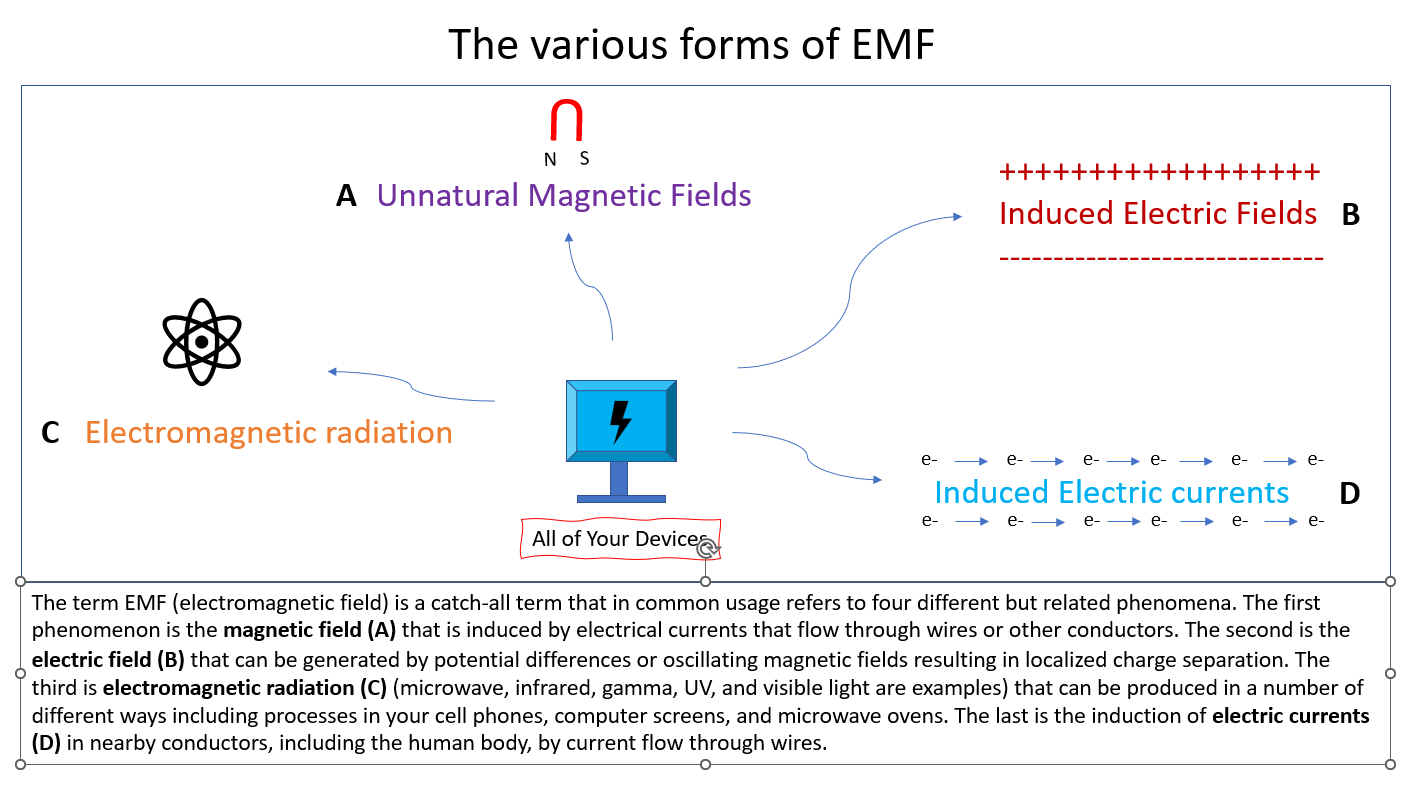
The effect of nnEMF on carcinogenesis (formation of cancer) in humans is not possible to measure directly because we can’t do experiments on humans, but recent reviews of the collective evidence from epidemiological (indirect) studies range from concluding that the word is not out on nnEMF causing human cancer to concluding that nnEMF clearly cause human cancer (see Caplan et al 2000, Baan et al 2011, and Miller 2018). This range in the scientific evidence for causing cancer has stoked a long-lived controversy that is alive and well today, and is discussed at length by Carpenter (2019). What is not controversial, however, is the fact that nnEMF cause cellular perturbations of the sort that often lead to cancer. This has been extensively documented in the scientific literature. For example, Kim and colleagues (2018) review numerous EMF studies that show a variety of perturbations in neurons, including mitochondrial oxidative damage, disturbance of voltage gated calcium channels that control release of neurotransmitters, and DNA damage. The following are examples of these studies. Sun et al (2016) examined DNA damage in normal mouse embryonic fibroblasts; in well controlled experiments, their work shows a clear connection between double and single strand DNA breaks and exposure to radio waves 1800 Mhz at 4W/kg (cell phones emit at about 1-2W/kg; note that radio waves are a form of electromagnetic radiation, not an electric or magnetic field). Earlier studies by the same authors demonstrated that the same treatments induced DNA damage in cultured human skin fibroblasts and Chinese hamster lung fibroblasts but not in four other cell lines. Shahbazi-Gahrouei et al (2017) observed proliferative effects of extremely low frequency non-ionizing magnetic fields on primary (derived directly from human volunteers) human adipose stem cells, and Santini et al (2018) review the adverse effects of electromagnetic fields and low frequency electromagnetic radiation on oxidative stress in the mitochondria of reproductive cells (the egg and sperm). That last body of literature provides many examples of disturbances in spermatogonia and oocytes caused by a variety of electric and magnetic fields, and the authors conclude by emphasizing the growing body of evidence for the role of nnEMF in oxidative damage to the mitochondria of reproductive cells and subsequent detrimental effects on reproductive health.
Another question is whether nnEMF adversely affect the water component of the cell and body. Two important properties of water are its ability to act as a solvent for all of the molecules in the cell (including the extra-cellular fluid) and its ability to form hydration shells around all of the ions and molecules of the cell. Despite the pressing importance of questions about the effects of nnEMF on the solution and hydration shell characteristics of water in the cell, they remain largely unexplored. These phenomena are difficult to study in actual cells, but some inroads have been made in ex vivo (outside of the cell) systems. Laage et al (2017) review the methods used to study water structure and hydration shells of biological molecules. They describe the fluctuating local electric fields that occur in the vicinity of membranes and large macromolecules of the cell. Importantly, they point out that maybe the most important challenge is for us to understand the responses of hydration dynamics to perturbations. While not discussed in their review, clearly some of these most important questions relate to the potential adverse effects of nnEMF on water dynamics in the cell and body. Non-experimental molecular dynamics studies have been conducted with electric field simulations (He 2018; Marracino 2015). These studies showed that in simulated conditions, the water molecules repolarize and reorient in electric fields. Furthermore, hydration shells around ions were profoundly affected by electric fields in the MD simulations by He et al (2018). While not empirical in nature, these simulations tell us that based upon what we already know, we can expect significant changes in the behavior of the water in its ability to properly hydrate biological molecules when exogenous electric fields are applied. Some experimental work has also been done exploring the effects of magnetic fields on water structure of with various aqueous solutions (Pang and Deng 2008; Pang et al 2012). These studies show that the properties of ex vivo water are influenced by magnetic and electric fields. Altogether, these results lead us to suspect that exogenous electric and magnetic fields as well as non-native radiation might perturb the water molecules as well as all of the charged molecules of the cellular milieu.
Despite the fact that nnEMF undoubtably cause cellular perturbations, current official information from the US National Cancer Institute, the World Health Organization, and the US Food and Drug Administration states that there is no known cancer risk associated with nnEMF. The reasons for this are unclear because they do not reference any scientific literature when making this claim. These statements are formulated by periodic recommendations from scientific advisory boards which appear to have largely ignored the evidence for detrimental effects of nnEMF. To this point, Carpenter (2019) reviewed the literature, concluding that there are clear funding biases in the literature related to nnEMF and cancer, and that these biases are caused by very clear conflicts of interest. The journal Microwave News has long published well-written commentary and reviews of the science aimed at understanding the effects of non-ionizing radiation on cells, animals, and the human body. For example, one report in 2016 describes a study in rats showing that chronic exposure of rats to cell phone signals led to significant increases of brain tumors (MN 2016). Another (MN 2016/2019) summarizes a study by Smith-Roe et al in 2020 showing that radiofrequency radiation in the range employed by the cell phone industry cause double-stranded DNA breaks and describes interviews with Motorola executives who deny the DNA damage poses a risk of cancer. Many experts in the field have concluded that nnEMF are problematic. A compelling example of this can be seen in the 2019 Collaborative for Health & Environment webinar entitled ‘Invisible Hazards: State of the Science on EMF Impacts and Steps for Policy Change’ features three EMF experts discuss the quantum mechanical basis of EMF induced cellular perturbations (some of which manifest in the mitochondria) as well as what is, in their opinion, clear epidemiological evidence for the cancer connection. The presenters also explain from direct experience the ways in which the nnEMF generating industries, primarily cell phone, have inappropriately influenced public safety policies.
Our assessment is that the scientific evidence for cellular perturbations cause by a variety of nnEMF in a number of different cell types incontrovertible, and that the dangers of chronic nnEMF exposure are real. EMF at levels produced by many of our devices are known to cause DNA and mitochondrial damage, both of which can lead to cancer. So, despite statements made to the contrary by some of our most respected institutions, we think it is prudent to minimize to the extent possible all exposure to electronic devices that emit EMF. C. Cooke has published a home health guide describing strategies for reducing or eliminating EMF exposure in your home and workplace (https://wholehomeandbodyhealth.com/). N. Pineault in his 2019 book (which would rank as satire if it weren’t mostly true) also provides a roadmap for reducing EMF in your life, along with bitingly sarcastic critique of the lack of safety standards in the industry. As a layman, he reviews some of the compelling scientific evidence for the adverse effects of various nnEMF, pointing out that corporate profiteering is largely responsible for the lack of sufficient safety standards.
Note: Readers should also be aware that therapeutic applications of electric and magnetic fields in controlled environments are being experimented with in a variety of clinical settings, including cancer treatment. Electric and magnetic fields appear to exert either proliferative or anti-proliferative effects on cultured tumor cells, depending on energy levels and pulse frequencies (discussed in Destefanis et al 2015; Meijer and Geesnik 2018; Scarfi 2019; Romeo and Sannio 2025). In their discussion of the data, Destefanis and colleagues note that close examination of the body of literature reporting paradoxical proliferative and anti-proliferative effects of EMF on cancers cells shows that is the experimental conditions (field strength, pulse frequency, etc) which determine the effect. They go on to show in their study that their particular magnetic fields reduced proliferation of human colon cancer and melanoma cell lines. They isolated mitochondria and showed that they exhibited reduced membrane potential, suggesting that the anti-proliferative effects were related to a reduction in mitochondrial function of the cancer cells. It is likely that these very same sorts of mitochondrial disturbances that impede proliferation of cancer cells actually contribute to the formation of the cancer cells in the first place.
Baan, R., Grosse, Y., Lauby-Secretan, B., El Ghissassi, F., Bouvard, V., Benbrahim-Tallaa, L., ... & Straif, K. (2011). Carcinogenicity of radiofrequency electromagnetic fields. The lancet oncology, 12(7), 624-626.
Caplan, L. S., Schoenfeld, E. R., O'Leary, E. S., & Leske, M. C. (2000). Breast cancer and electromagnetic fields—a review. Annals of Epidemiology, 10(1), 31-44.
Carpenter, D. O. (2019). Extremely low frequency electromagnetic fields and cancer: How source of funding affects results. Environmental research, 178, 108688.
Destefanis, M., Viano, M., Leo, C., Gervino, G., Ponzetto, A., & Silvagno, F. (2015). Extremely low frequency electromagnetic fields affect proliferation and mitochondrial activity of human cancer cell lines. International Journal of Radiation Biology, 91(12), 964-972.
Edre, H. A. R. (2016). Risk of Cancer Due to Electromagnetic Field Exposure: A Review. International Journal of Public Health and Clinical Sciences, 3, 1-10.
He, Z., Cui, H., Hao, S., Wang, L., & Zhou, J. (2018). Electric-field effects on ionic hydration: a molecular dynamics study. The Journal of Physical Chemistry B, 122(22), 5991-5998.
Kim, J. H., Lee, J. K., Kim, H. G., Kim, K. B., & Kim, H. R. (2018). Possible effects of radiofrequency electromagnetic field exposure on central nerve system. Biomolecules & therapeutics, 27(3), 265.
Maffei, M. E. (2022). Magnetic fields and cancer: epidemiology, cellular biology, and theranostics. International Journal of Molecular Sciences, 23(3), 1339.
Marracino, P., Liberti, M., d'Inzeo, G., & Apollonio, F. (2015). Water response to intense electric fields: A molecular dynamics study. Bioelectromagnetics, 36(5), 377-385.
Meijer, D. K., & Geesink, H. J. (2018). Favourable and unfavourable EMF frequency patterns in cancer: perspectives for improved therapy and prevention. Journal of Cancer Therapy, 9(03), 188.
Miller, A. B., Morgan, L. L., Udasin, I., & Davis, D. L. (2018). Cancer epidemiology update, following the 2011 IARC evaluation of radiofrequency electromagnetic fields (Monograph 102). Environmental research, 167, 673-683.
MN 2016 https://microwavenews.com/news-center/ntp-cancer-results
Pang, X. F., & Deng, B. (2008). The changes of macroscopic features and microscopic structures of water under influence of magnetic field. Physica B: Condensed Matter, 403(19-20), 3571-3577.
Pang, X. F., Deng, B. O., & Tang, B. O. (2012). Influences of magnetic field on macroscopic properties of water. Modern Physics Letters B, 26(11), 1250069.
Pineault, N. (2019). The Non-tinfoil Guide to EMF’s. N&G Media, Inc.
Romeo, S., & Sannino, A. (2025). Special Issue “Electric, Magnetic, and Electromagnetic Fields in Biology and Medicine: From Mechanisms to Biomedical Applications: ”. Bioengineering, 12(7), 739.
Santini, S. J., Cordone, V., Falone, S., Mijit, M., Tatone, C., Amicarelli, F., & Di Emidio, G. (2018). Role of mitochondria in the oxidative stress induced by electromagnetic fields: focus on reproductive systems. Oxidative Medicine and Cellular Longevity, 2018(1), 5076271.
Scarfì, M. R., Mattsson, M. O., Simkó, M., & Zeni, O. (2019). “Electric, Magnetic, and Electromagnetic Fields in Biology and Medicine: From Mechanisms to Biomedical Applications”. International Journal of Environmental Research and Public Health, 16(22), 4548.
Shahbazi-Gahrouei, D., Razavi, S., Koosha, F., & Salimi, M. (2017). Exposure of Extremely-Low Frequency (ELF) magnetic field may cause human cancer. Acta Medica International, 4(1), 32-39.
Smith-Roe, S. L., Wyde, M. E., Stout, M. D., Winters, J. W., Hobbs, C. A., Shepard, K. G., ... & Witt, K. L. (2017, September). Evaluation of the genotoxicity of cell phone radiofrequency radiation in male and female rats and mice following subchronic exposure. In ENVIRONMENTAL AND MOLECULAR MUTAGENESIS (Vol. 58, pp. S66-S66). 111 RIVER ST, HOBOKEN 07030-5774, NJ USA: WILEY.
Sun, C., Wei, X., Fei, Y., Su, L., Zhao, X., Chen, G., & Xu, Z. (2016). Mobile phone signal exposure triggers a hormesis-like effect in Atm+/+ and Atm−/− mouse embryonic fibroblasts. Scientific Reports, 6(1), 37423.
Zhang, Y., Lai, J., Ruan, G., Chen, C., & Wang, D. W. (2016). Meta-analysis of extremely low frequency electromagnetic fields and cancer risk: a pooled analysis of epidemiologic studies. Environment international, 88, 36-43.